

EU AI Act for Marketers: 2026 Timeline
The EU AI Act is the European Union’s risk-based law governing AI systems. For marketers, the key 2026 date is 2 August 2026, when transparency duties for AI-generated and AI-assisted content, including chatbot and deepfake disclosure, become enforceable. High-risk AI obligations were deferred to December 2027.
What is the EU AI Act, and why should marketers care?
The EU AI Act (Regulation (EU) 2024/1689) is the first comprehensive AI law of its kind, sorting AI systems into risk tiers and attaching obligations to each. Marketing teams sit inside its scope the moment they use generative AI for copy, images, chatbots, personalisation or ad targeting aimed at people in the EU, regardless of where the business is based.
Two things make this a marketing problem rather than only a legal one: content-labelling duties that touch everyday output, and penalties that reach into the tens of millions of euros for non-compliance.
What changed on 2 August 2026?
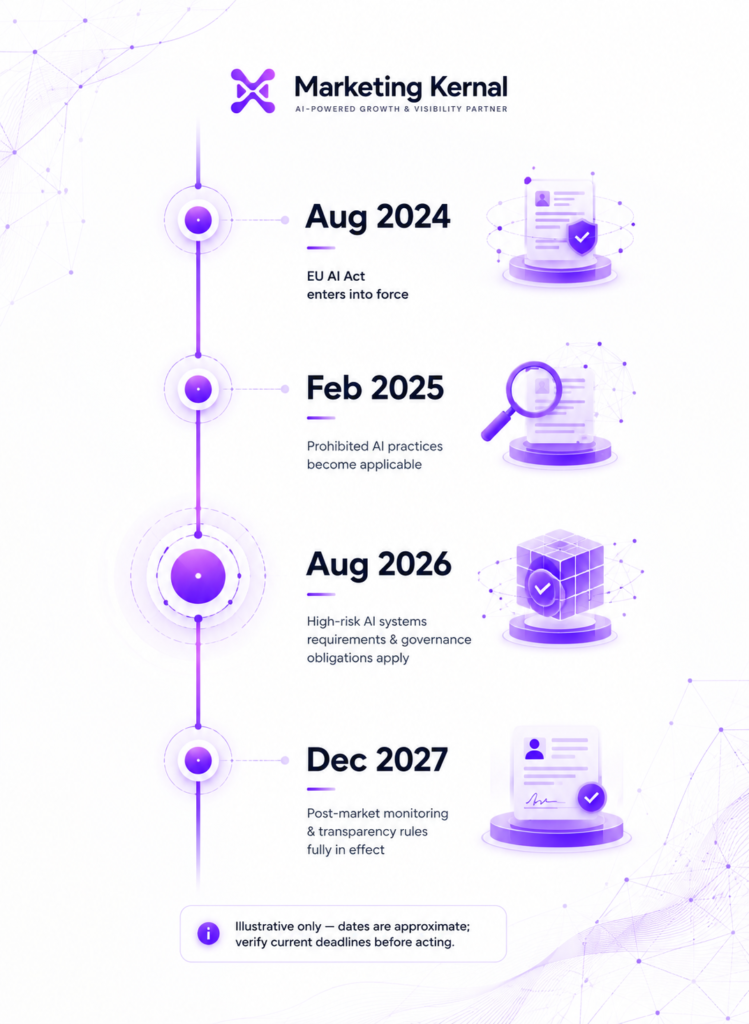
2 August 2026 is the headline date in the current timeline. According to Data Protection Report (26 July 2026), the AI Act’s transparency obligations under Article 50 became applicable from that date, covering disclosure of AI-generated content, chatbot interactions and deepfakes, while the more demanding high-risk system requirements were pushed back.
The same source notes a limited grace period running to 2 December 2026 for machine-readable, AI-generated content labelling on systems already on the market before 2 August 2026, for that specific obligation only.
Which AI Act obligations apply to marketing teams?
Three duties matter most for a marketing function:
- Disclose AI-generated or AI-manipulated content, including synthetic images, audio and video, in a way a person can recognise.
- Label chatbot interactions clearly, so a website visitor knows they are talking to an AI system, not a person.
- Flag deepfakes and AI-altered media used in campaigns, even when the alteration is minor editing rather than full synthesis.
- Maintain a basic record of which AI tools generated which assets, since accountability sits with the deployer, not just the tool vendor.
- Build an AI literacy plan for the team producing or approving AI-assisted marketing content.
What is the timeline for high-risk AI systems?
High-risk obligations, the most demanding tier, cover things like automated hiring, credit scoring or biometric systems. These were deferred by the Digital Omnibus on AI. Reporting from Legiscope (29 July 2026) puts the new backstop date for Annex III high-risk systems at 2 December 2027, a shift most marketing teams will not need to act on directly, since AI-driven ad targeting and personalisation generally sit outside this tier.
Marketing teams should still track it: a tool bought today for one purpose can be reclassified if its use case changes.
How does the EU AI Act interact with GDPR?
The two frameworks run alongside each other rather than replacing one another. GDPR governs personal data and individual rights; the AI Act governs the AI system itself. A marketing team using AI to process customer data for personalisation needs to satisfy both at once.
GDPR vs the EU AI Act, at a glance:
| Question | GDPR | EU AI Act |
| What it governs | Personal data processing and individual privacy rights | Safety, transparency and risk classification of AI systems |
| Who it targets | Data controllers and processors | Providers, deployers and distributors of AI systems |
| Marketing-relevant duty | Lawful basis, consent, data subject rights for AI-driven targeting | Disclosure of AI-generated content and chatbot interactions |
| Maximum penalty | Up to €20 million or 4% of global turnover | Up to €35 million or 7% of global turnover |
What should marketers do before the next deadline?
A practical starting checklist:
- Audit every AI tool touching customer-facing content, from copy generators to chatbot platforms.
- Add visible AI-generated labels to synthetic images, video and audio used in EU-facing campaigns.
- Confirm chatbot and virtual-assistant interfaces disclose they are AI, not a human agent.
- Document which tools produced which assets, so accountability is traceable if asked.
- Run a short AI-literacy session for anyone approving AI-assisted marketing output.
Key takeaways
- 2 August 2026 is the operative date for AI Act transparency duties: content labelling, chatbot disclosure and deepfake flagging.
- High-risk AI obligations were deferred to 2 December 2027 under the Digital Omnibus on AI, easing near-term pressure on most marketing use cases.
- GDPR and the AI Act apply together, not instead of each other, whenever AI touches personal data.
An AI visibility and compliance check now costs far less than reconstructing documentation after an audit request.
Does the EU AI Act apply to marketing agencies outside the EU?
Yes, if the output reaches people located in the EU. The Act applies based on where effects are felt, not where the business is headquartered.
Do I need to label every AI-assisted marketing image?
Synthetic or AI-manipulated visual, audio and video content used in EU-facing campaigns needs a disclosure under Article 50, with a grace period to 2 December 2026 for content already in circulation before 2 August 2026, per that specific obligation.
Is a marketing chatbot a high-risk AI system?
Generally no. Most customer-service or lead-qualification chatbots fall under the transparency tier, not the high-risk tier, though this depends on the specific use case.
What is the penalty for non-compliance?
Fines can reach €35 million or 7% of global annual turnover, whichever is higher, for the most serious breaches, alongside GDPR’s separate penalty regime where personal data is involved.
Where should a marketing team start?
With an inventory: which AI tools are in use, what they produce, and whether that output currently discloses its AI origin. A structured AI visibility audit covers this alongside broader AI-search presence.