

GEO vs SEO: What’s the Difference? (2026 Guide)
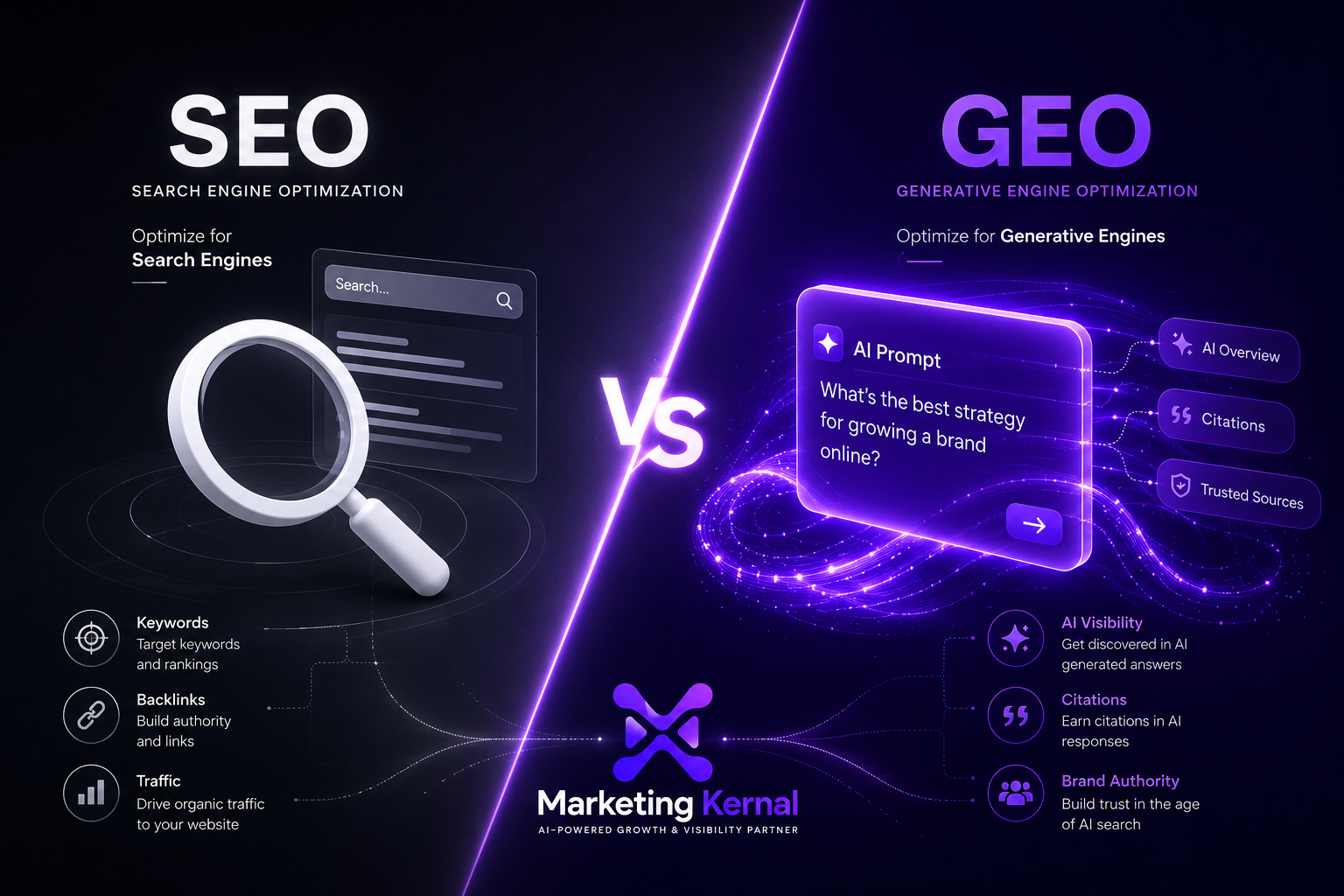
GEO (generative engine optimisation) is the practice of earning presence inside AI-generated answers from tools like ChatGPT, Perplexity, Gemini and Google AI Overviews. SEO (search engine optimisation) is the practice of earning positions in ranked search results. They overlap heavily, but they compete for different real estate, are measured differently, and reward different signals.
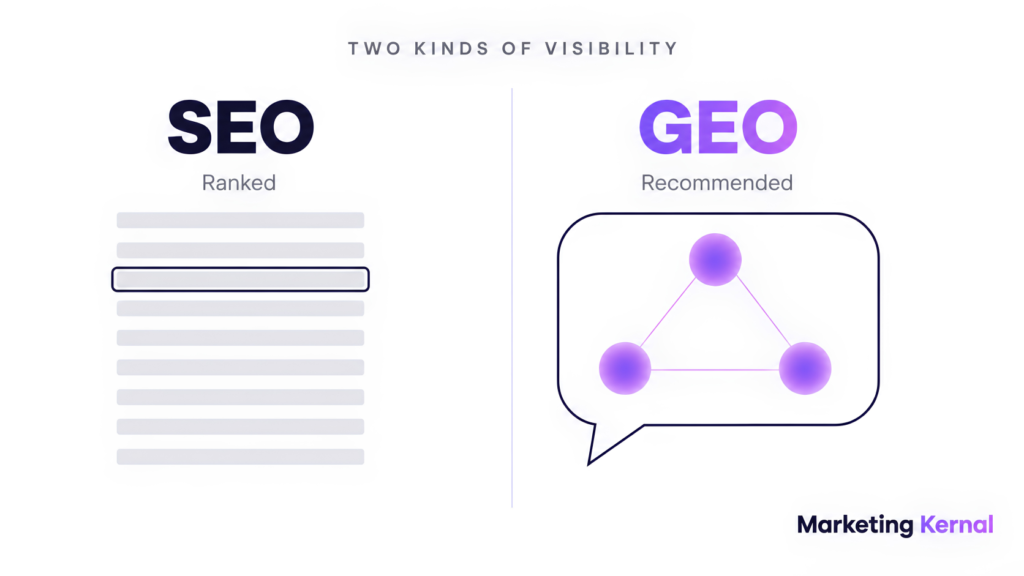
If you only remember one line from this guide, make it this: SEO gets you ranked, GEO gets you recommended. In 2026 most brands need both, in a deliberate order. This guide covers what each discipline actually does, where they overlap, where they genuinely differ, and a straightforward way to decide which deserves your next quarter of effort.
What is SEO in 2026?
SEO is the mature discipline: making pages crawlable, relevant and authoritative so they rank in classic search results. Its core mechanics have not changed. Technical health, content that satisfies intent, and links that signal trust still determine who occupies the ten organic slots on a results page.
What has changed is the page those slots sit on. Ranked results increasingly appear below an AI-generated summary, and clicks behave accordingly. According to Similarweb’s 2026 Generative AI Landscape report (July 2026), AI Overviews now appear on 43% of Google searches, up from 15% a year earlier. Ranking first still matters, but on a growing share of queries it no longer means being first thing the searcher reads.
What is GEO in 2026?
Generative engine optimisation is the newer discipline: influencing whether and how AI systems mention, cite and recommend your brand when they compose an answer. The answer engine does not present ten options. It synthesises one response and names perhaps two to five brands, chosen from what the model knows, retrieves and trusts. Our generative engine optimisation service page describes the full programme; the short version is that GEO works on three inputs: how clearly machines understand your identity, how easily your content can be lifted into an answer, and how often independent sources corroborate you.
That last input surprises people most. Muck Rack’s May 2026 analysis found that 84% of AI citations come from earned media rather than brand-owned pages. In practice this means digital PR and earned coverage do work in GEO that no amount of on-site publishing can replicate.
GEO vs SEO: the side-by-side comparison
| Dimension | SEO | GEO |
| Competes for | Ranked positions on a results page | Mentions inside one synthesised answer |
| Winners per query | Ten organic slots | Typically two to five brands, sometimes one |
| Primary currency | Clicks from rankings | Citations and recommendations |
| Core signals | Relevance, links, technical health | Entity clarity, extractable answers, earned corroboration |
| Where results appear | Google, Bing results pages | ChatGPT, Perplexity, Gemini, Copilot, AI Overviews |
| Measurement | Rank tracking, organic clicks | AI share of voice, citation logs across assistants |
| Time horizon | Months, compounding | Weeks for entity fixes, months for corroboration |
| Failure mode | Invisible on page two | Absent, or worse, misdescribed in the answer |
Where do GEO and SEO overlap?
Roughly sixty to seventy percent of the work is shared, which is why “GEO replaces SEO” is wrong and “GEO is just SEO rebranded” is also wrong. The shared foundation:
- Crawlable, fast, technically clean sites. AI systems retrieve content the same way crawlers always have; a page a bot cannot reach cannot be cited.
- Genuinely useful content that satisfies a real question. Neither discipline rewards filler any more.
- Structured data. Schema markup helps classic rich results and helps models resolve who you are.
- Authority earned from real coverage. Links move rankings; the same coverage, as a corroborating mention, moves citations.
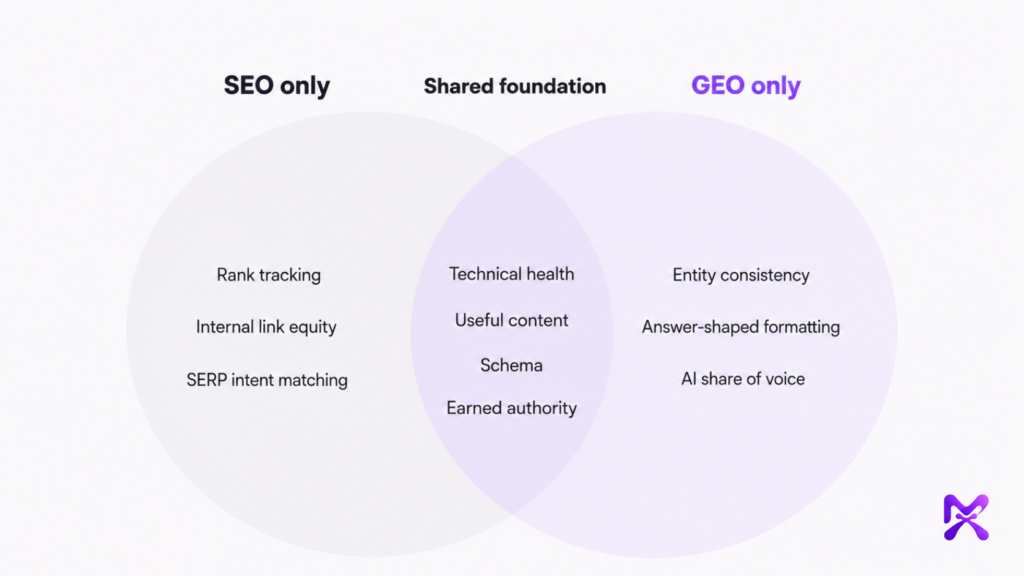
The differences live at the edges: GEO cares about entity consistency across every profile you hold, about answer-shaped formatting, and about presence on the specific third-party sources each engine demonstrably reads. SEO cares about ranking-specific factors like internal link equity and query-level intent matching that answer engines flatten into one composed response.
Does ranking well in Google mean AI engines will cite you?
Less than it used to, and the gap is widening. BrightEdge’s February 2026 analysis found that only 17% of AI Overview citations come from pages ranking in the organic top ten, down from 76% in mid-2024. Citation presence has become a separate visibility layer from ranking. A page can rank third and never be cited; a page ranking twentieth can be quoted in the answer because it states the answer more extractably or sits on a source the system trusts for that topic.
This is the single most practical finding in the whole GEO vs SEO debate. It means you can no longer read your rank tracker as a proxy for visibility. You have to measure the answer layer directly, which is exactly what our AI visibility programme is built to do: a fixed panel of real buyer questions run across the major assistants, logged monthly, scored as share of voice.
Which should you prioritise: GEO or SEO?
It depends on where your buyers already are and what you already have. A simple decision sequence:
- If your technical SEO is broken (indexing issues, slow pages, crawl errors), fix that first. It is the shared foundation; GEO cannot compensate for pages machines cannot read.
- If you rank well but AI answers never mention you, prioritise GEO: entity foundations, answer-shaped restructuring of your best pages, then earned corroboration.
- If you are invisible in both, run them together but sequence within each topic: publish the extractable asset, then earn the mention that corroborates it.
- If your category is question-heavy (software, finance, health-adjacent, B2B services), weight GEO higher: question-form queries are exactly where AI answers appear most.
Two adjacent terms worth understanding as you plan: answer engine optimisation, which we define fully in What is AEO?, focuses on the content-structure layer of this work, and the tactical end of GEO is covered step by step in our guide to getting cited in ChatGPT.
Key takeaways
- SEO earns ranked positions; GEO earns mentions inside AI answers. Different real estate, different currencies.
- AI Overviews now appear on 43% of Google searches (Similarweb, July 2026), so the answer layer is not optional.
- Only 17% of AI Overview citations come from the organic top ten (BrightEdge, Feb 2026): rankings no longer predict citations.
- 84% of AI citations come from earned media (Muck Rack, May 2026): corroboration beats self-publishing.
- Sequence: shared technical foundation first, then entity clarity, extractable content, earned mentions, monthly measurement.
Is GEO replacing SEO?
No. GEO extends SEO into the answer layer. The technical and content foundations are shared; abandoning SEO would starve the sources AI engines read. Budgets are shifting toward GEO, not away from search entirely.
Is GEO the same as AEO?
They overlap. AEO (answer engine optimisation) focuses on structuring content so systems can extract answers. GEO is broader: it adds entity management and earned corroboration across generative engines. Most teams practise both under one programme.
How do I measure GEO?
Run a fixed panel of real buyer questions across ChatGPT, Perplexity, Gemini and AI Overviews monthly. Log whether you are mentioned, what is said, and which sources are cited. Track share of voice against competitors over time.
How long does GEO take to show results?
There is no guaranteed timeline. Entity and structure fixes can reflect within weeks because engines re-retrieve frequently; earned corroboration compounds over months. Treat any firm promise with suspicion.
Do I need different content for GEO and SEO?
Usually not different content, but differently structured content: a definition-led opening, question-form headings, honest FAQs and clean tables serve both rankings and citations from the same page.
Ready to see where you stand? The Marketing Kernal GEO Checklist condenses this guide into a working audit sheet, and the generative engine optimisation programme is where we run it for you. Start with the checklist, and when you want the answer layer measured properly, book a strategy conversation.