How to Get Your Brand Cited in ChatGPT (2026)
To get cited in ChatGPT, make your brand easy for the model to identify, easy to quote, and corroborated by sources it already trusts. In practice that means consistent entity data everywhere you appear, content structured for extraction, earned coverage on publications AI systems read, and monthly measurement of what the model actually says.
That single paragraph is the whole method. The rest of this guide turns it into seven concrete steps you can run on a WordPress site with a small team, explains why each step matters mechanically, and shows you how to verify progress without guessing.
Why does ChatGPT cite some brands and ignore others?
ChatGPT composes answers from two layers. The first is what the model learned in training: a compressed picture of the public web in which well-documented, consistently described brands are simply easier to recall correctly. The second is live retrieval: when browsing is on, the system searches, reads a handful of sources, and cites what it used. You influence the first layer slowly, through the footprint you build; you influence the second layer faster, through what exists to be retrieved right now.
The composition of that second layer is the strategic headline. Muck Rack’s May 2026 citation analysis found that 84% of AI citations come from earned media rather than brand-owned pages. Your own site matters, but the deciding vote usually belongs to what independent sources say about you. Getting cited is therefore a publishing problem and a reputation problem at the same time.
What kind of sources does ChatGPT actually cite?
| Source type | Example surfaces | What earns the citation |
| Trade and industry press | Sector publications, marketing and tech trades | Original data, expert commentary, news relevance |
| Reference and profile sites | Wikipedia-adjacent entities, Crunchbase, directories | Consistent, factual entity records |
| Community platforms | Reddit, Q&A sites, professional forums | Genuinely helpful participation, disclosed and non-promotional |
| High-authority blogs and docs | Well-maintained expert content, documentation | Extractable answers, named sources, freshness |
| Your own site | Service pages, guides, FAQs | Clear definitions, structured data, honest claims |
Notice what is missing: bulk links, keyword-stuffed pages, and anything bought. Citation is earned corroboration, which is why our digital PR programme treats AI engines as a second audience for every placement.
The seven-step citation method
Run these in order. Each step feeds the next, and skipping ahead is the most common reason brands publish heavily and still never appear.
[Build the seven steps below as a Rank Math HowTo block. Bold line = step title, remainder = description.]
Step 1: Baseline what ChatGPT says today.
Write ten to fifteen real buyer questions (the ones prospects actually ask, including “best X for Y” and “who should I use for Z”). Ask them in ChatGPT with browsing on and off, and record three things per question: are you mentioned, what exactly is said, and which sources are cited. This log is your baseline and your progress meter.
Step 2: Fix your entity before your content.
The model must be certain who you are. Use one exact brand name, one one-line description and one website everywhere: your site, LinkedIn, Crunchbase, directories, social profiles. Add Organization schema with a complete sameAs list connecting every profile. Ambiguity does not get resolved in your favour; it gets you omitted.
Step 3: Restructure your best pages for extraction.
Pick the five pages most relevant to your baseline questions. Give each a 40 to 60 word definition-led opening that answers the core question outright, question-form H2s, one clean table where a table is the clearest form, and an honest FAQ. Answer-shaped content is what retrieval quotes.
Step 4: Publish the missing answers.
Your baseline log will show questions where no good source exists at all. Those gaps are your content plan. Write the genuinely best page on that exact question, with a named source for every statistic and a dateModified you keep current.
Step 5: Earn corroboration on sources the engines read.
Pitch expert commentary, contribute to the trade press, answer journalist requests, participate honestly in relevant communities. Two or three quality mentions on surfaces AI demonstrably cites outweigh dozens of self-published posts. Never buy placement; engines and readers both punish it eventually.
Step 6: Keep everything verifiably fresh.
AI search re-retrieves constantly and prefers current sources. Update statistics, refresh dateModified honestly when content genuinely changes, and remove claims you can no longer verify. Stale pages quietly fall out of answers.
Step 7: Re-measure monthly and iterate.
Re-run the exact same question panel every month. Log mentions, sentiment and cited sources. Compare against your baseline and against two or three competitors. The questions where you remain absent set next month’s priorities. This loop is the discipline; everything else is technique.
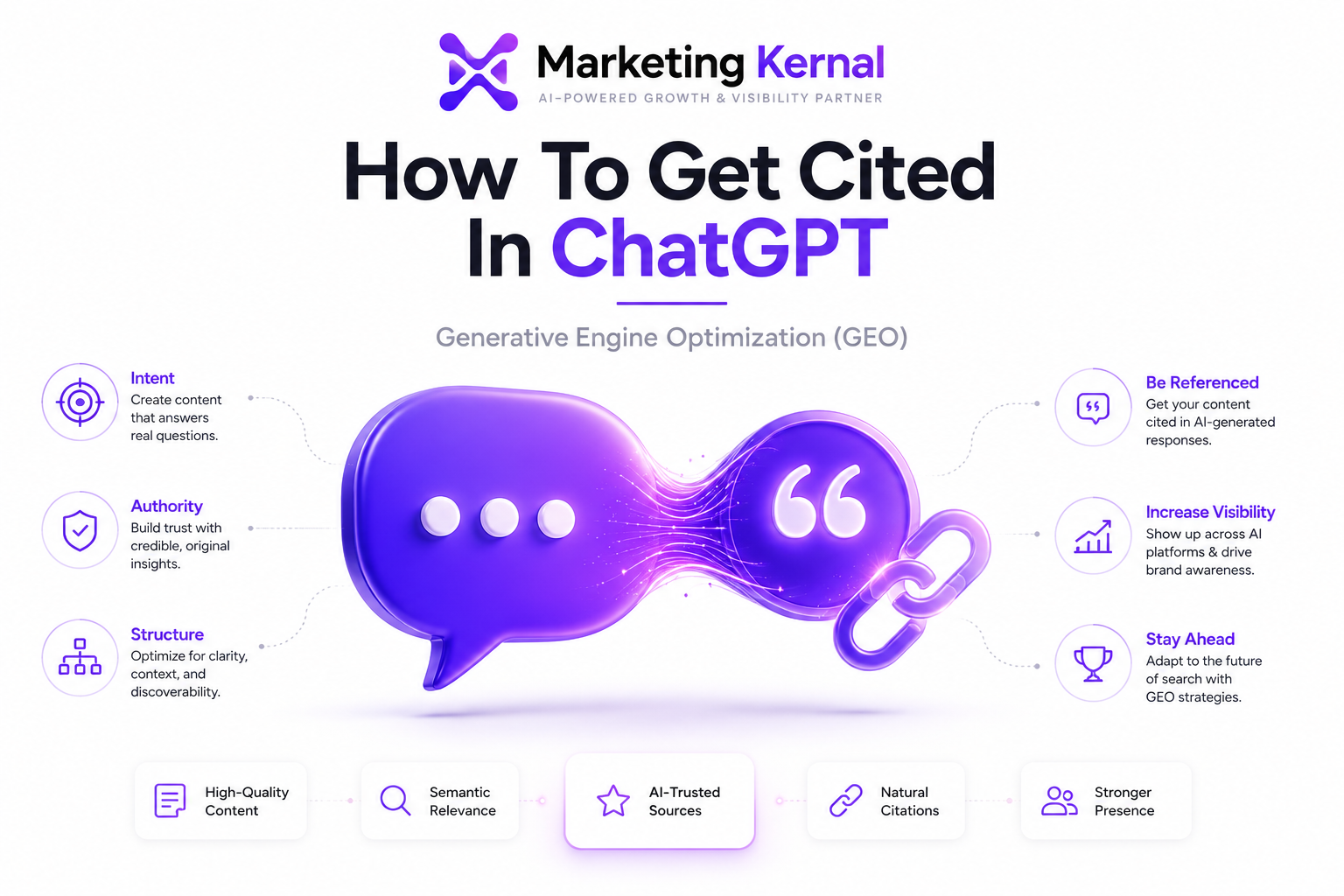
[Insert Image 2: chatgpt-citation-method-steps.png]
How is getting cited in ChatGPT different from ranking in Google?
They reward overlapping foundations and different finishing moves. Rankings reward relevance and link equity page by page; citations reward identity clarity, quotability and third-party corroboration brand-wide. The evidence that these have diverged is stark: BrightEdge’s February 2026 data shows only 17% of AI Overview citations now come from pages in the organic top ten. The full comparison lives in our GEO vs SEO guide, and the Google-specific version of this playbook is covered in how to appear in Google AI Overviews.
One foundation deserves special emphasis because it is invisible when done well: entity work. Consistent structured identity is what lets a model connect your Crunchbase profile, your LinkedIn page, your founder’s byline and your website into one confident answer about you. That discipline is entity SEO, and it is step two for a reason.
What NOT to do
- Do not buy mentions, links or “AI visibility placements” in bulk. 84% of citations being earned media is precisely why bought signals fail.
- Do not fabricate statistics, reviews or case studies to look citable. Models increasingly cross-check, and one exposed invention poisons trust in everything else you publish.
- Do not spam communities with brand mentions. Undisclosed promotion gets removed, and the removal history is itself visible to systems.
- Do not chase every assistant at once. Baseline on ChatGPT plus one other engine your buyers use, get the loop working, then widen.
Key takeaways
- Citation = identity clarity + extractable content + earned corroboration + freshness, measured monthly.
- 84% of AI citations come from earned media (Muck Rack, May 2026); what others publish about you usually decides the answer.
- Only 17% of AI Overview citations come from the organic top ten (BrightEdge, Feb 2026); ranking is not citing.
- Baseline first, entity second, content third, corroboration fourth. Order matters.
- The monthly re-measurement loop is the method; individual tactics only work inside it.
Can I pay to be recommended by ChatGPT?
Not in organic answers. There is no placement product for the answer itself, which is exactly why earned presence is defensible once you have it.
How long does it take to get cited in ChatGPT?
Retrieval-layer changes (entity fixes, restructured pages, new earned mentions) can surface within weeks because the system reads live sources. Training-layer recall shifts over months. No honest practitioner guarantees a timeline.
Does ChatGPT use my website at all?
Yes, both as training material over time and as a retrievable source when browsing. But your site competes with every independent source about you, so it must be the clearest, best-structured statement of who you are and what you know.
Should I block AI crawlers instead?
If AI answers are becoming a discovery channel for your buyers, blocking removes you from consideration without removing the conversation. Most commercial brands are better served by showing up well than by opting out.
How do I check citations without asking manually every time?
Manual monthly panels work at small scale and cost nothing. As volume grows, share-of-voice tooling automates the same loop; the method stays identical either way.
Want the baseline done for you? The Marketing Kernal AI Citation Audit runs your buyer-question panel across the major assistants and hands you the gap list. It lives inside our AI visibility programme, and a strategy conversation is the natural next step once you have seen your gaps.