
Digital PR for AI Citations: The Playbook (2026)
Digital PR for AI citations means earning third-party editorial coverage, expert commentary and original data placements on the sites AI engines already trust, rather than buying links or distributing press releases, because earned media now accounts for the large majority of what ChatGPT, Claude and Gemini actually cite when they recommend a brand.
Most digital PR programmes are still built to win backlinks and domain authority, but that is not the currency AI engines are spending anymore. This playbook sets out what digital PR for AI citations actually involves, why press releases and paid placements have stopped working the way they used to, and a repeatable structure for pitching, placing and tracking coverage that AI engines will actually cite. It also sets out the most common mistakes that sink an otherwise well-resourced programme, since most of the failure modes here are avoidable once the target list and success metric are built around citation data rather than the metrics a traditional PR report was built to show.
What Is Digital PR for AI Citations, and How Is It Different From Traditional Digital PR?
Digital PR for AI citations is the practice of earning coverage, mentions and original data placements on third-party sites specifically because AI engines draw on those sites when generating answers, not only because a link improves a domain’s search ranking. The mechanics of pitching, relationship-building and story development are largely unchanged from traditional digital PR. What changes is the target list and the success metric. Traditional digital PR measures domain authority, referring domains and organic ranking lift. Digital PR for AI citations measures whether a placement gets picked up as a source inside an AI-generated answer, on which engine, and how consistently that happens over time. A placement can be a traditional SEO success, strong domain, solid anchor text, and still be functionally invisible to AI engines if it sits on a site those engines rarely draw from, which is why the target list has to be built around citation data, not domain authority alone. This is also why a digital PR retainer priced and reported the old way can look entirely successful on its own terms, strong placements, healthy domain ratings, a tidy coverage report, while contributing almost nothing to how often the brand shows up when a buyer actually asks an AI engine for a recommendation.
Why Does Earned Media Now Decide Whether AI Engines Recommend a Brand?
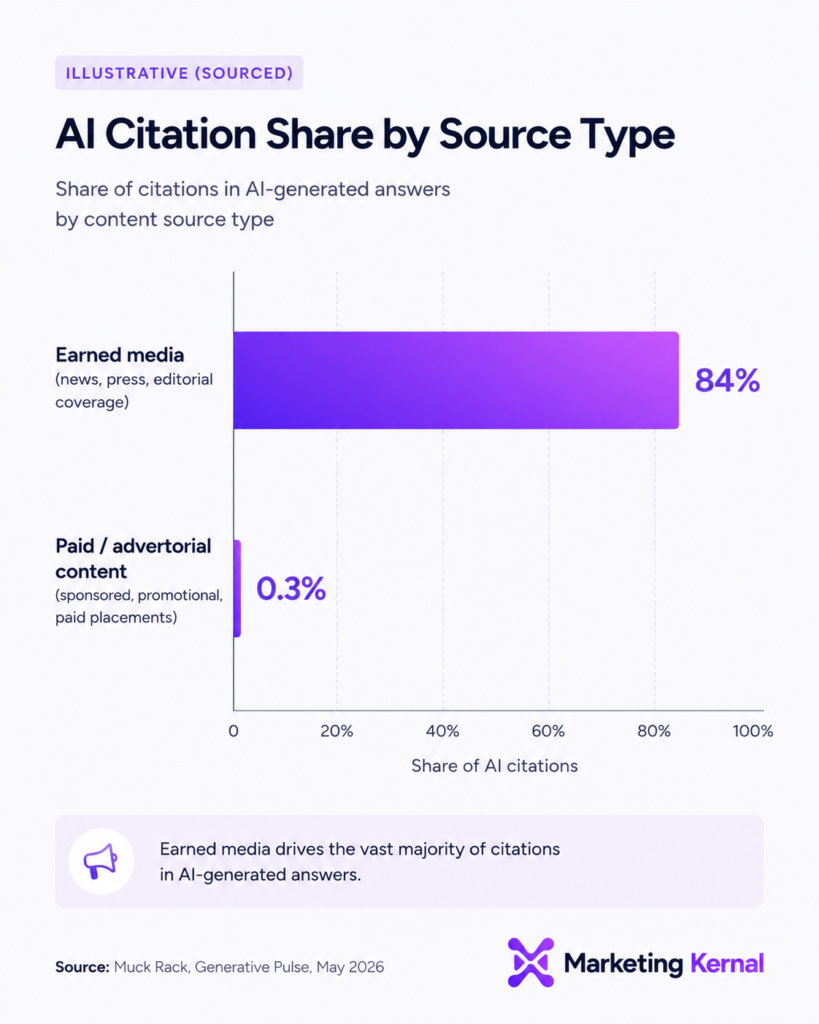
According to Muck Rack’s Generative Pulse study (May 2026), which analysed more than 25 million links cited across ChatGPT, Claude and Gemini in 17 industries, earned media accounts for 84% of all AI citations, while paid and advertorial content accounts for just 0.3%. Journalism alone contributes 27% of that total. That figure has held in the 82% to 89% range across three editions of the same study stretching back to July 2025, which suggests it is a structural feature of how these engines evaluate sources, not a temporary quirk. The practical implication for a marketing budget is blunt: a brand that is investing heavily in owned content and paid distribution, but has little third-party editorial coverage, is optimising for a channel that carries a small fraction of the weight AI engines actually assign when deciding who to recommend. It is worth being precise about what “earned media” covers in this context too: bylined thought-leadership pieces, independent journalism, analyst-grade research coverage and expert-commentary placements all count, while sponsored or advertorial content, however well written, sits in the 0.3% that barely registers.
Why Don’t Press Releases Work the Way They Used To?
Because wire-distributed press releases carry almost no citation weight on their own. BuzzStream’s 2026 research found that press releases distributed via wire syndication account for just 0.04% of AI citations, despite press release volume having grown roughly five-fold industry-wide over the same period. That does not mean press releases are worthless; a release can still be the trigger that gets a journalist to write an independent story, and independent journalism is exactly the kind of coverage AI engines cite heavily. The mistake is treating wire distribution itself as the deliverable, rather than as one input into securing genuine third-party editorial pickup. A brand that measures success by how many wire outlets carried a release, rather than by how many independent publications wrote their own story off the back of it, is measuring the wrong thing.
How Do You Choose Which Publications and Platforms to Target?
Target selection should be led by citation data, not by domain authority or circulation numbers alone. An Ahrefs study of 75,000 brands found that brand web mentions correlate roughly three times more strongly with AI Overview visibility than backlinks do, which is a useful reminder that being talked about, even without a link, carries real weight with AI engines. In practice this means checking whether a prospective publication or platform actually turns up as a cited source when real category queries are run across ChatGPT, Perplexity and Google AI Overviews, using the same kind of citation panel described in our data study on which sources AI cites most, before committing outreach time to it. A publication with a strong domain rating but no visible presence in AI-cited answers for the relevant category is a weaker target than a smaller, more specialised outlet that shows up repeatedly.
What Does a Digital PR Pitch Built for AI Citation Look Like?
The following sequence covers what to build into a pitch and its supporting asset before it goes out.
- Lead the pitch with an original data point or expert claim that a journalist cannot get from a competitor, since AI engines favour content with something genuinely new to say.
- Attach a citable, self-contained statistic or quote the journalist can lift directly into their own piece without needing to paraphrase it.
- Offer the founder or a named expert for direct comment, since a quoted, credentialed source strengthens the resulting piece’s own citation-worthiness.
- Provide a short, factual company description with consistent entity details, so any resulting mention resolves back to the same recognisable brand every time.
- Avoid embedding a hard sales pitch or pricing in the pitch itself, since editorially independent coverage is what AI engines weight most heavily.
- Follow up with a one-line reminder of the data point, not a repeat of the full pitch, if there is no response within a reasonable window.
How Does Digital PR for AI Citations Differ From Traditional Digital PR in Practice?
The two approaches share the same craft but diverge on target selection and measurement, as the table below sets out.
| Dimension | Traditional digital PR | Digital PR for AI citations |
| Primary goal | Backlinks and domain authority | Third-party editorial coverage that AI engines actually cite |
| Target selection | Domain rating, circulation, referring-domain value | Citation data: does this outlet actually appear in AI-cited answers for the category |
| Success metric | Referring domains, organic ranking lift | Citation frequency and share of voice across AI engines |
| Best-performing asset | A strong story with a natural link | Original data, expert commentary, or a quotable, self-contained claim |
| Weakest asset | N/A | Wire-distributed press releases alone, which BuzzStream found account for just 0.04% of AI citations |
How Does the E.A.R.N. Framework Apply to a Digital PR Campaign?
MK plans every digital PR campaign against the same E.A.R.N. framework used across its AI visibility work: Entity-linked mentions, Authoritative host domains, Recency, and Natural context. Entity-linked mentions means every placement names the brand clearly and links it to a consistent entity profile, so an AI engine can confidently attribute the mention rather than treating it as a vague, unlinked reference. Authoritative host domains means prioritising outlets that show up in real citation data for the category, not simply the outlets with the highest domain rating on paper. Recency means treating a placement as most valuable in the weeks immediately after it runs, and building a steady drumbeat of coverage rather than a single annual campaign, since freshness fades from citation weight over time. Natural context means every mention is earned through genuine editorial value, never a disguised link scheme or a pay-for-coverage arrangement, which matters doubly here because AI engines increasingly discount citation patterns that look manufactured. The same framework and the underlying citation data are described in more detail in our resource on which sources AI cites most.
How Do You Track Whether a Digital PR Campaign Is Earning AI Citations?
Coverage volume alone does not answer the question that matters, which is whether any of that coverage actually gets cited. Tracking needs a fixed panel of real category queries, run consistently across ChatGPT, Perplexity and Google AI Overviews, checking specifically whether a recent placement appears among the cited sources rather than only checking whether the placement itself ranks or drives referral traffic. A piece of coverage that never shows up in that panel, even from a well-known outlet, is not doing the AI-citation job, whatever else it might be doing for brand awareness. Running the same panel before and after a campaign is the clearest way to attribute a citation gain to a specific placement rather than to background noise in the data. It is also worth tracking a secondary signal alongside citations directly: whether the brand starts appearing in AI answers as a named entity even without a direct link, since, as the earlier data on brand mentions suggests, that kind of unlinked recognition can move ahead of, or independently of, a formal citation.
What Mistakes Most Often Sink a Digital PR for AI Citations Programme?
The most common failure is treating this as a rebrand of an existing link-building programme rather than a genuinely different target list and success metric. A second is chasing the highest domain-rating outlets available regardless of whether those outlets ever actually turn up in AI-cited answers for the relevant category, which wastes outreach effort on placements that look impressive in a media report but do nothing for citation share. A third is over-relying on wire-distributed press releases as the primary tactic, given how little citation weight they carry on their own. A fourth, and the one that is hardest to self-diagnose, is running a campaign and declaring it a success based on coverage volume or sentiment alone, without ever checking whether any of that coverage shows up when the brand’s own category queries are actually run across the AI engines its buyers use. Each of these is avoidable with the citation-led target selection and panel-based tracking described above, but only if the programme is measured against citation data from the start rather than retrofitted onto a plan built for a different goal.
What Does a 90-Day Digital PR for AI Citations Rollout Look Like?
A realistic rollout runs in three phases rather than a single push.
Days 1 to 30: Baseline and Target List
- Run the citation panel described above to establish which outlets currently get cited in the brand’s category, before any new outreach begins.
- Build a target list ranked by citation evidence, not domain authority alone, and identify two or three original data points or expert angles worth pitching.
Days 31 to 60: Pitch and Place
- Pitch the highest-priority targets first, using the structure in the numbered sequence above, and track every placement in a citation register.
- Support each placement with consistent entity details so mentions resolve back to the same brand profile across outlets.
Days 61 to 90: Measure and Refine
- Re-run the citation panel and compare it against the baseline, noting which specific placements correspond to any new citations.
- Drop outlets that generated coverage but no citation lift, and reinvest that effort in the outlets and formats that did.
Key Takeaways
- Earned media accounts for 84% of AI citations across ChatGPT, Claude and Gemini, while paid content accounts for just 0.3% (Muck Rack, May 2026).
- Wire-distributed press releases carry almost no citation weight on their own, at just 0.04% of AI citations (BuzzStream, 2026).
- Brand web mentions correlate roughly three times more strongly with AI Overview visibility than backlinks do (Ahrefs).
- Target selection should be led by citation data, checking whether an outlet actually appears in AI-cited answers, not by domain authority alone.
A 90-day rollout of baseline, pitch, and measure gives a digital PR programme a realistic structure for proving AI-citation impact.
What is digital PR for AI citations?
It is the practice of earning third-party editorial coverage, expert commentary and original data placements specifically on the sites AI engines like ChatGPT and Google AI Overviews already cite, rather than pursuing backlinks and domain authority as the primary goal.
Do press releases help with AI visibility?
Barely on their own. BuzzStream’s 2026 research found wire-distributed press releases account for just 0.04% of AI citations, though a release can still trigger independent journalism, which does carry real citation weight.
How much of AI citation comes from earned media versus paid content?
According to Muck Rack’s May 2026 Generative Pulse study, earned media accounts for 84% of AI citations across ChatGPT, Claude and Gemini, compared with just 0.3% for paid and advertorial content.
How do you choose which publications to target for AI citation?
Check whether a publication actually appears as a cited source for real category queries across the major AI engines, using a citation panel, rather than relying on domain authority or circulation numbers alone.
How long does a digital PR for AI citations programme take to show results?
A realistic first cycle runs about 90 days: roughly a month to baseline current citations and build a target list, a month to pitch and place coverage, and a month to remeasure and refine, though citation gains can appear sooner for well-placed, highly citable coverage.
| Ready to see where you stand? Most brands running a digital PR programme today are still measuring it against backlinks and reach, not against whether AI engines actually cite the coverage. Book a Strategy Session with the Marketing Kernal team to see how your current PR activity is showing up, or not showing up, in AI-cited answers, and where the highest-value placements for your category are likely to be. |