


How to Get Cited in Perplexity AI (2026 Guide)

To get cited in Perplexity, publish a fast-indexed page with a direct, quotable answer in the first 40 to 60 words, back every claim with a dated statistic, keep passages under 100 words, and maintain a visible presence in the community discussions Perplexity’s real-time retrieval already draws from, such as Reddit threads.
Perplexity works differently from Google and from ChatGPT, and that difference changes what “getting cited” actually requires. Because Perplexity performs real-time web retrieval on every query rather than answering from a fixed index or static training data, new content can be cited within hours of publication, but only if it is structured for fast retrieval and sits inside the mix of sources Perplexity already trusts. This guide sets out how Perplexity selects sources, how that differs from Google AI Overviews and ChatGPT, and the structural and entity work that gives a page a realistic shot at a citation slot.
What Is Perplexity and Why Does Getting Cited There Matter?
Perplexity is an AI answer engine that runs a live web search for every query and assembles its answer from a short list of retrieved sources, cited inline rather than buried in a reference list. That real-time retrieval model is the single biggest difference between Perplexity and the other major AI engines, and it is also why Perplexity citations behave more like a live auction than a static ranking. A citation earned today can be lost tomorrow if a fresher or better-structured page appears, and a brand-new page can win a citation slot within hours if it is well structured, something that is far rarer on engines drawing from a slower-moving index. For B2B and SaaS brands especially, Perplexity has expanded well beyond a consumer curiosity tool into a genuine research and shortlisting surface, which means a missing citation on a buyer-intent query is a missed shortlist appearance, not just a missed click. Its growing enterprise and search-API footprint means the same retrieval logic now also feeds other products built on top of it, so a citation strategy aimed at Perplexity has a reach beyond the consumer app itself.
How Does Perplexity Choose Which Sources to Cite?
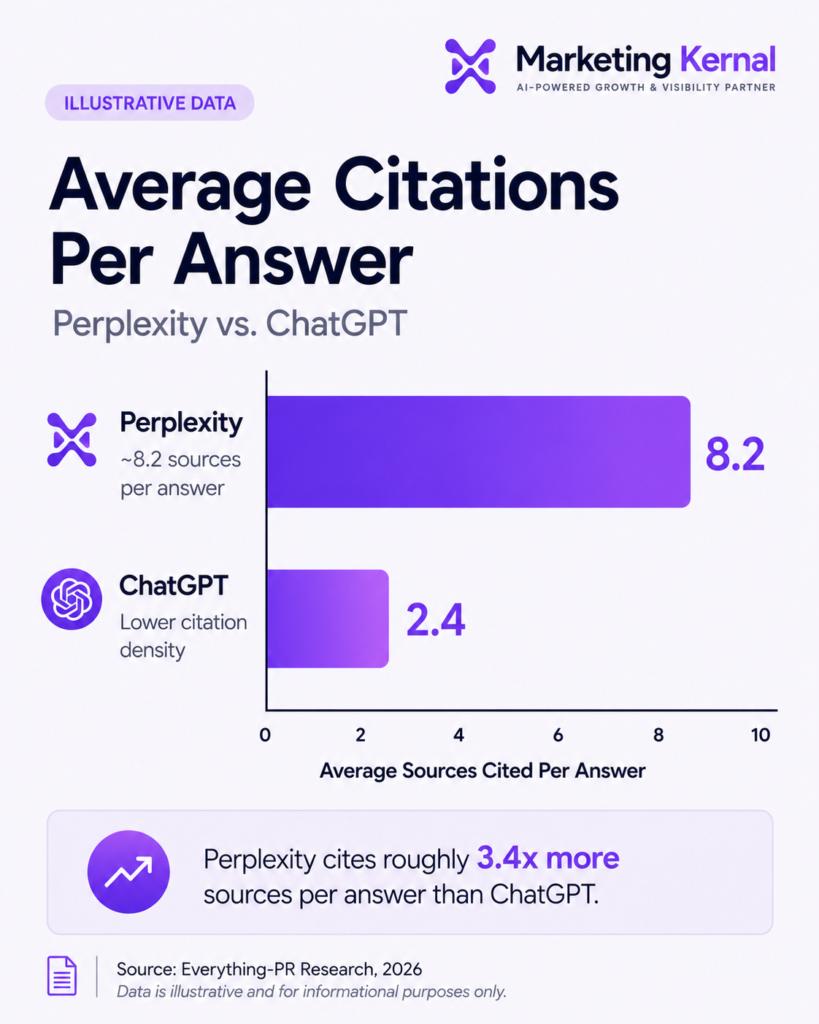
According to Everything-PR Research (2026), Perplexity cites an average of 8.2 sources per answer, roughly 3.4 times the citation density of ChatGPT, which means more citation slots are available per query, but also more competition for each one. Selection leans heavily on freshness and retrievability: a page that loads fast, states its point plainly near the top, and carries a clear publication or update date is easier for the retrieval layer to evaluate and trust than a page that buries its answer under long introductory prose. Community content plays an outsized role in that selection too. Perplexity draws heavily on discussion platforms alongside owned brand pages, which means a citation strategy built only around a company’s own website is incomplete; the brand also needs a presence in the conversations where its category is already being discussed. A typical Perplexity answer draws on roughly ten pages evaluated during retrieval and cites three to five of them for a simple query, rising to ten or more for a complex, multi-part question, which is a useful way to think about how scarce and competitive each citation slot actually is.
Does Ranking on Google Help You Get Cited in Perplexity?
It helps, but it is not the deciding factor the way it is for organic search. Perplexity’s retrieval layer evaluates a page independently for each query rather than relying purely on an existing rank, so a page with strong Google rankings but a slow load time, thin structure, or no recent update can still be passed over. Conversely, a newly published page with none of that ranking history can be cited quickly if it answers the query directly and loads fast enough for the retrieval layer to evaluate it within the response window. The practical implication is that a Perplexity citation strategy cannot simply piggyback on existing SEO wins; it needs its own structural and freshness work layered on top.
How Do You Structure a Page So Perplexity Can Cite It?
The following sequence covers the moves that most directly improve a page’s chances inside Perplexity’s real-time retrieval process.
- Publish and get indexed quickly by Google and Bing, since Perplexity’s retrieval draws on the live index within hours of a page going up.
- Lead with a direct, quotable answer in the first 40 to 60 words, ahead of any scene-setting.
- Attach a dated statistic or original data point to each major claim, something the retrieval layer can lift and attribute cleanly.
- Keep every passage under 100 words so it works as a single retrievable, self-contained unit.
- Maintain an active, honest presence in the community discussions relevant to the topic, since Perplexity weights that content heavily alongside owned pages.
- Mark up the page with Article and, where relevant, HowTo schema so the retrieval layer can parse its structure quickly under time pressure.
- Refresh statistics and the dateModified value on a regular cycle, since real-time retrieval consistently favours recency over historical authority.
What Technical Factors Affect Whether Perplexity Can Retrieve a Page in Time?
Retrieval happens inside a response window measured in seconds, not the days or weeks a search crawler has to revisit and reassess a page, so technical performance carries more weight for Perplexity than it does for most SEO work. Page load speed is the clearest lever: a page that renders slowly, or that hides its main content behind heavy client-side JavaScript, risks being skipped simply because the retrieval layer could not evaluate it fast enough within the query window. Clean, server-rendered HTML with the answer present in the initial page load, rather than injected afterwards, gives the retrieval layer the best chance of reading the page correctly on the first pass. Redirect chains, oversized images and blocking scripts all add latency that a static search index can absorb but a real-time retrieval call cannot. None of this is exotic technical SEO; it is the same performance hygiene most sites already know they should fix, just with a sharper deadline attached to it now that a slow page can lose a citation slot in real time rather than simply losing a fraction of a point in a ranking algorithm.
What Role Does Community Content Play in Perplexity Citations?
Community platforms, and Reddit in particular, carry unusually heavy weight inside Perplexity’s citation mix, more than on most other AI engines. Tinuiti’s January 2026 data found that roughly 31% of Perplexity’s citations come from social platforms, with Reddit the dominant single source within that share. That does not mean owned content is unimportant; it means owned content competes for a smaller share of citation slots than brands typically assume, and a chunk of the remaining slots go to threads the brand does not control directly. The realistic response is not to abandon owned content, but to treat participation in relevant, on-topic discussions as part of the same citation strategy as the page itself, always disclosed honestly and never as disguised self-promotion.
How Is Optimising for Perplexity Different From Google AI Overviews and ChatGPT?
The three engines share the underlying discipline of generative engine optimisation but differ in retrieval mechanics and source mix, as the table below sets out.
| Dimension | Perplexity | Google AI Overviews | ChatGPT |
| Retrieval method | Real-time web retrieval on every query | Google’s existing organic index | Static training data plus a Bing-powered retrieval layer |
| Typical citation density | Higher; averages around 8.2 sources per answer | Varies with answer length | Lower than Perplexity on comparable queries |
| Dominant source type | Heavy weight on community platforms alongside owned pages | Mix of top-ranking organic pages and community sources | Varies by query, generally lower community weight |
| Speed to first citation | Can be hours after publication | Follows normal organic indexing and crawl timelines | Depends on retrieval layer and index freshness |
For a full breakdown of the entity and schema work common to all three engines, see our resource on how to get cited in ChatGPT, and for the discipline that underpins all of it, see what separates GEO from traditional SEO.
How Does the C.I.T.E. Framework Apply to Perplexity Citations?
MK applies the same C.I.T.E. framework used across its AI visibility work — Context-first answers, Identity signals, Trustworthy sourcing, and Extractable structure — with one adjustment for Perplexity’s real-time retrieval. Context-first answers still means leading with the point, but on Perplexity that point needs to be retrievable within the response window, which puts more weight on page speed than it does for a static index. Identity signals means the organisation resolves consistently across the web, which matters here because Perplexity is more likely than other engines to cite a community thread mentioning the brand rather than the brand’s own page, so identity consistency has to extend into those conversations too. Trustworthy sourcing means every claim carries a dated, named source, since Perplexity’s retrieval layer favours pages it can verify quickly. Extractable structure means short, self-contained passages and accurate schema, exactly as with any AI engine, but tested specifically for how fast the page loads and how quickly its answer can be lifted. This work sits inside
MK’s AI visibility service, and the same checklist underpins the AI Citation Audit referenced below for teams that want to see where their own pages currently stand. Applied consistently, the framework turns Perplexity citation work from a one-off publishing push into a repeatable review a team can run every time a page is refreshed, rather than a special project reserved for a handful of flagship articles.
How Do You Track Whether You Are Being Cited in Perplexity?
Perplexity does not currently surface citation data the way Search Console reports organic rank, so tracking has to be done through a fixed prompt panel: a consistent set of real buyer-intent queries, run on a regular schedule, checking whether the brand appears among the cited sources and in what position. Because Perplexity’s citation set can change within hours, this panel needs to run more frequently than an equivalent Google AI Overview panel to be useful, and a single check tells very little on its own. The value comes from tracking movement over time and connecting any gain or loss back to a specific structural or freshness change, which is the same discipline MK applies to its own AI share of voice tracking internally.
Key Takeaways
- Perplexity performs real-time retrieval on every query, so citation share can shift within hours rather than weeks.
- Perplexity cites an average of 8.2 sources per answer, roughly 3.4 times the density of ChatGPT (Everything-PR Research, 2026).
- Community platforms, especially Reddit, carry unusually heavy weight in Perplexity’s citation mix alongside owned pages.
- Strong Google rankings help but do not guarantee a Perplexity citation; page speed and freshness matter independently.
- The same C.I.T.E. discipline used for Google AI Overviews applies to Perplexity, with extra weight on speed and community presence.
What is Perplexity AI?
Perplexity is an AI answer engine that runs a live web search for each query and assembles its answer from a short list of retrieved sources, citing them inline rather than listing ranked links.
How is getting cited in Perplexity different from ranking in Google?
Perplexity evaluates a page independently for each query through real-time retrieval, rather than relying mainly on an existing rank, so page speed, structure and freshness matter more relative to historical authority than they do for organic search.
Does Reddit really matter for Perplexity citations?
Community platforms, and Reddit specifically, carry unusually heavy weight in Perplexity’s citation mix. Tinuiti’s January 2026 data found roughly 31% of Perplexity citations come from social platforms, with Reddit dominant within that share.
How quickly can new content get cited in Perplexity?
New content can be cited within hours of being indexed by Google or Bing, since Perplexity’s retrieval draws on the live web index rather than a fixed training cut-off, though this depends on how quickly and clearly the page states its answer.
What is the difference between optimising for Perplexity and general GEO?
General GEO principles — entity clarity, structured data, extractable passages — apply across engines, but Perplexity specifically rewards page speed, recency and a visible presence in community discussions more heavily than Google AI Overviews or ChatGPT do.