Entity SEO is the practice of making a brand resolvable as a single, consistent, machine-identifiable organisation across the web, so that search and answer engines can attribute claims to it with confidence. It optimises the organisation rather than the page, and it is what decides whether an engine will name you at all.
Most brands that ask why they never appear in AI answers assume they have a content problem. They read the advice, they write the guides, they add the FAQ sections, and nothing changes. The content was rarely the issue.
An answer engine has to decide who is making a claim before it decides whether to repeat it. If it cannot work out which organisation your website belongs to, or if it finds three slightly different versions of that organisation, it does the safe thing and names somebody it is more confident about. Entity SEO is the work that removes that doubt.
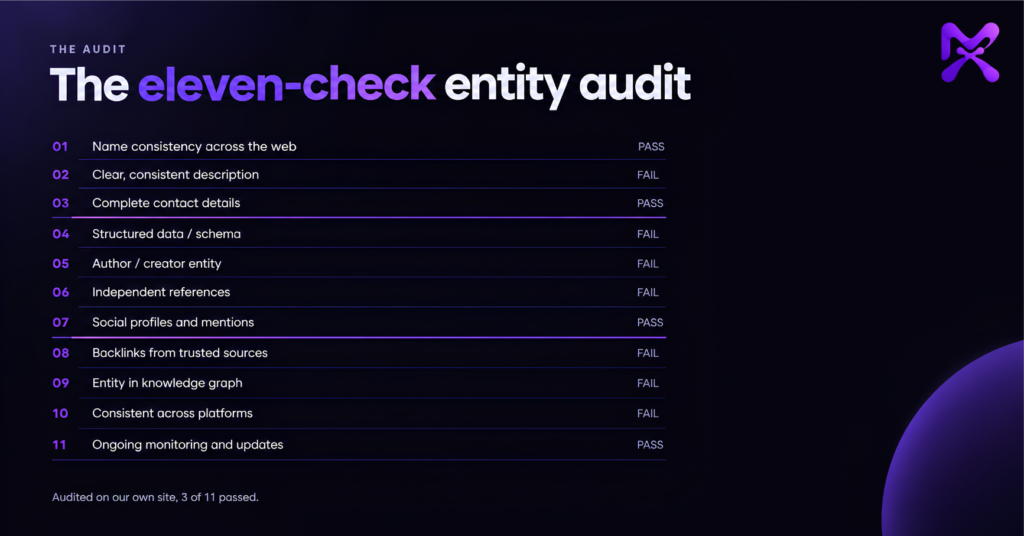
We ran our own eleven-check entity audit on marketingkernal.com before publishing this. We passed three. The rest of this article is the checklist we used and what each failure actually costs.
What is an entity, in the way a search engine means it?
An entity is a thing the engine holds a record of independently of any single web page. A company, a person, a product, a place. The record exists in a knowledge graph, and it collects attributes: a name, a description, an address, a founder, a set of profiles that all refer to the same thing.
The distinction that matters is this. A page is something an engine reads. An entity is something an engine believes in. You can rank a page without the engine having any confident idea who published it. You cannot be recommended that way, because a recommendation is a statement about an organisation, not about a document.
Why do AI engines lean on entities more than keyword matching?
Because a generated answer carries implied endorsement. When a search engine returns ten links, the reader does the judging. When an assistant names one company, the assistant has judged. That shifts the burden, and systems handle that burden by preferring things they can identify and corroborate.
Corroboration is the part most brands underestimate. According to Muck Rack’s Generative Pulse study What Is AI Reading? (May 2026 edition), earned media accounted for 84% of AI citations across ChatGPT, Claude and Gemini, against 0.3% for paid and advertorial content, based on an analysis of more than 25 million links across 17 industries. What an organisation says about itself is necessary. What other people say about it is what makes the engine confident enough to name it.
This is why entity work and earned coverage are the same project viewed from two ends. The consistency work makes you identifiable. The coverage makes you credible. Neither one alone gets you named. The coverage side is covered in digital PR built for AI citation.
What breaks entity resolution?
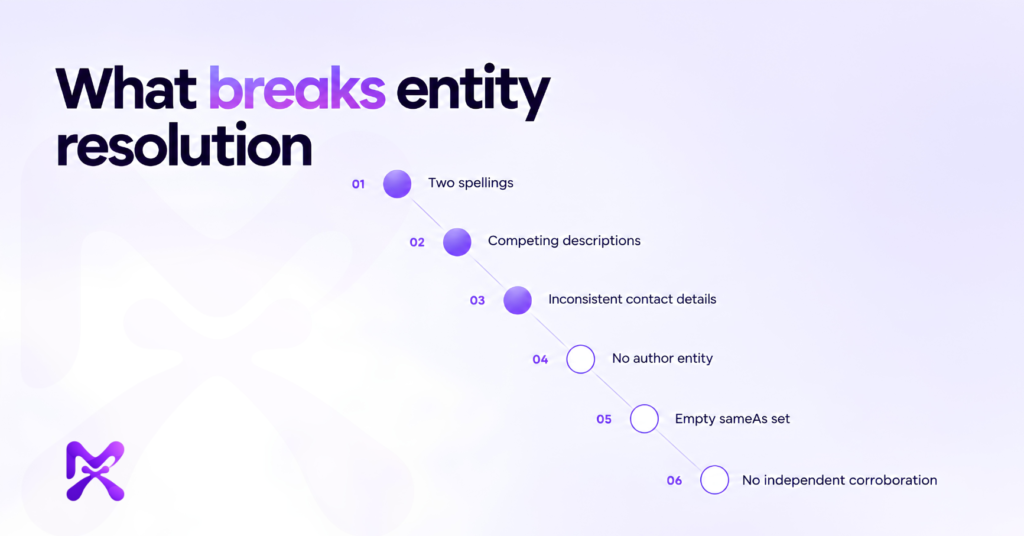
Six failure modes account for almost everything we see. They are listed in the order they usually do damage.
- Two spellings of the brand name. The single most expensive error, because every profile, schema block and mention created under the wrong one becomes a permanent external record pulling in the opposite direction.
- Competing descriptions. Three different one-line explanations of what the company does, on three different pages, gives the engine three candidate answers and no reason to prefer any of them.
- Inconsistent contact details. Two addresses or two phone numbers is the classic version. An engine reading both has to decide which organisation it is looking at, and the safe conclusion is that it might be two.
- No author entity. Content published by nobody in particular is content the engine cannot attribute. A named author with no profile to resolve to is only marginally better than no name at all.
- An empty or wrong sameAs set. If the structured data claims profiles that do not exist, or omits the ones that do, the engine cannot connect your website to your presence anywhere else.
- No independent corroboration. Everything written about the organisation is written by the organisation. This is the failure that cannot be fixed on your own website, and it is why entity work eventually becomes a public relations project.
Failures one to five are cheap to fix and usually take an afternoon. Failure six takes a quarter. Fixing six before one to five is the common and expensive mistake: earning coverage for an organisation the engine cannot yet resolve wastes the coverage.
The eleven-check entity audit
This is the audit we run, and the one we ran on ourselves. It needs no tools. Work down it and mark each line pass or fail.
| SR | Check | What a pass looks like |
|---|---|---|
| 1 | Brand name | One spelling, everywhere. Domain, logo, title tags, body copy, footer and og:site_name all agree |
| 2 | Founder and team names | One legal spelling and one job title per person, across every page and profile |
| 3 | Company description | One sentence explaining what the organisation does, used identically in every meta description, bio and profile |
| 4 | Contact details | One address and one phone number, or a deliberate decision to publish neither and use email only |
| 5 | Domain | Every canonical tag points at the domain you actually own, with no encoding artefacts |
| 6 | Social profiles | Every profile linked from the site exists, resolves, and belongs to the organisation rather than a platform homepage |
| 7 | sameAs set | Contains every live profile and nothing that is not live |
| 8 | Organization schema | Present sitewide, with name, description, address and sameAs matching the visible page content |
| 9 | Person schema | An author archive exists and every article resolves to it |
| 10 | Services list | The services in the navigation match the services in the footer and the services in the schema |
| 11 | Third-party corroboration | The organisation appears on at least three independent sources it does not control |
For what it is worth, we failed two, three, four, six, seven, eight, nine, ten and eleven. Our own brand name appeared two ways on a single page. That is not a comfortable thing to publish, but it is the honest version, and every one of those is an afternoon of work rather than a strategy problem.
What is the sameAs set and why does it matter?
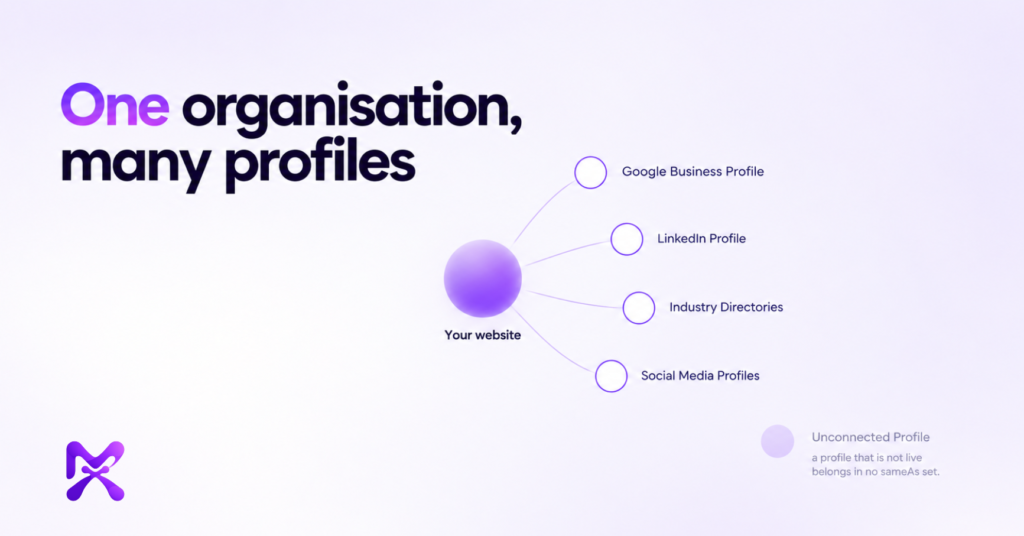
The sameAs property in your Organization schema is a list of URLs that all refer to the same entity as your website. Your LinkedIn page, your company profiles, your directory listings. It is the mechanism by which an engine connects a website to a presence it has encountered elsewhere.
Two rules govern it and both are frequently broken. It may contain only profiles that are live, because a sameAs pointing at nothing is worse than a short list. And it must be built after the profiles exist, not before, which sounds obvious and is routinely done in the wrong order. Structured data more broadly is covered in entity SEO services.
Where does Wikidata fit, and why is it last?
Almost every guide on this subject starts with Wikidata, and that is the step most likely to fail. Wikidata expects notability evidence: independent sources that establish the organisation is worth recording. Submitting without that evidence wastes the attempt, and a rejected or deleted entry is a worse starting position than no entry.
The order that works is unglamorous. Fix the name and the description. Register and complete the profiles you actually intend to maintain. Build the schema from those profiles. Earn three independent sources. Then approach Wikidata, with the sources in hand.
How do you know it is working?
Rankings will not tell you and neither will traffic, because entity resolution improves the chance of being named in an answer that frequently produces no click.
Ask the engines directly. Fix a small panel of questions, including at least one that asks the engine to describe your company by name, and run it across every assistant that matters to you on the same day each month. Record four things: whether the engine recognises the name, whether what it says is accurate, whether it resolves any name variants to one organisation, and which sources it draws on.
The first run is usually sobering and that is fine. The number is not the point. The trend is, and a panel that changes between runs produces no trend at all. How the two disciplines differ underneath all this is set out in why entities matter more than keywords in AI answers, and the definitional groundwork is in the AEO definition.
Key takeaways
- Entity SEO optimises the organisation, not the page. It decides whether an engine will name you at all.
- An engine has to identify who is making a claim before it decides whether to repeat it.
- Six failure modes cause most invisibility, and five of them are an afternoon of work.
- Independent corroboration is the sixth, it takes a quarter, and it cannot be done on your own website.
- Build in order: name, description, contact details, profiles, schema, coverage, then Wikidata last.
- Measure by asking the engines directly on a fixed panel and a fixed schedule. Rankings will not show you this.
Frequently asked questions
Is entity SEO the same as schema markup?
No. Schema markup is one tool entity SEO uses. Entity SEO is the broader work of making an organisation consistently identifiable, which includes the name, the description, the contact details, the profiles and the independent coverage. You can have flawless schema and still be unresolvable if the schema describes an organisation the rest of the web describes differently.
Do I need a Wikipedia page to have a knowledge graph entity?
No. A Wikipedia article makes it easier and faster, but knowledge graph entities exist for organisations with no Wikipedia presence. What is required is consistent self-description plus independent sources, and those sources do not have to be encyclopaedic.
How long does entity consolidation take?
The consistency work on your own properties is usually days rather than weeks. The corroboration half is measured in quarters, because it depends on other people publishing about you. Any timeline given without seeing the current state of both halves is guesswork.
What happens if my brand name is spelled two ways?
The engine may treat them as two organisations, or resolve them to one with lower confidence. Either way, mentions split between the variants instead of accumulating. Fix this before creating any new profile, schema block or listing, because each one becomes a permanent external record.
Can a small company build a recognised entity?
Yes, and often faster than a large one, because there are fewer conflicting records to reconcile. Small organisations usually fail on corroboration rather than consistency, which means the work is public relations rather than technical.
If you want the eleven checks run against your own site rather than doing it yourself, that is what we do.