

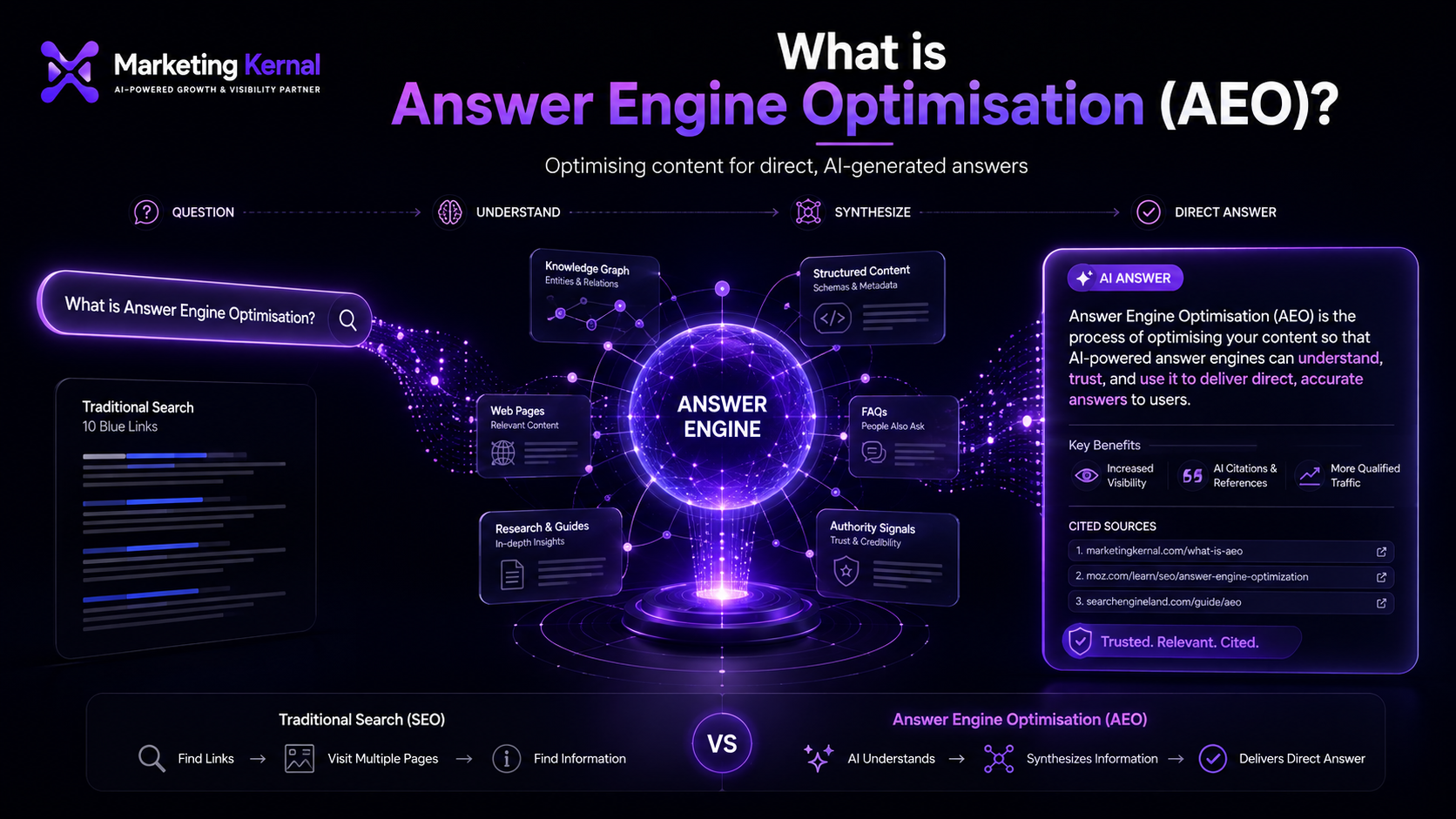
What is Answer Engine Optimisation (AEO)?
Answer engine optimisation (AEO, also spelled answer engine optimization) is the practice of structuring content so that AI assistants and answer engines can extract, quote and cite it accurately. Where classic SEO optimises pages to rank as links, AEO optimises the answers inside those pages to be lifted directly into AI-generated responses.
AEO exists because the interface changed. A growing share of searches now end in a composed answer rather than a click, and the systems composing those answers have a measurable preference for content shaped a particular way. This guide defines that shape precisely, shows the exact pattern to apply to any page, and explains how AEO relates to the two terms it is most often confused with.
Why does AEO matter in 2026?
Because question-shaped searches, the exact queries most businesses write content for, are where AI answers concentrate. Pew Research Center’s analysis of real user searches found that AI summaries appeared on about 60% of question-word searches (who, what, when, why), against far lower rates for short navigational queries. Similarweb’s 2026 Generative AI Landscape report (July 2026) puts AI Overviews on 43% of Google searches overall, up from 15% a year earlier.
Put plainly: if you publish informational content and it is not extractable, you are producing raw material for answers that will quote someone else. AEO is how you become the source that gets quoted.
AEO vs SEO vs GEO: how do they relate?
| Term | Optimises for | Core question it answers |
| SEO | Ranked positions in search results | Can this page be found and ranked? |
| AEO | Extraction and citation of answers within content | Can a machine lift a correct answer from this page? |
| GEO | Brand presence across generative engines as a whole | Do AI systems know, trust and recommend this brand? |
The three nest rather than compete: AEO is the content-structure layer inside GEO, and both stand on SEO’s technical foundations. The full comparison of the two bigger disciplines is in our GEO vs SEO guide; this article stays on the layer AEO owns, the answer itself.
What does an extractable answer actually look like?
There is a repeatable pattern, and you are reading it right now. Every element of this article follows the structure it describes. The pattern has five parts:
- A definition-led opening of 40 to 60 words that answers the core question outright, before any context or throat-clearing. This is the block engines lift most often.
- Question-form headings that mirror how people actually ask. “What does an extractable answer look like?” outperforms “Content structure best practices” because retrieval matches questions to questions.
- Self-contained sections. Each heading plus its first paragraph should make sense quoted alone, without the rest of the page.
- One honest table, list or step sequence where that is genuinely the clearest form. Structured elements are disproportionately extracted.
- A named source for every statistic, in the form “According to [Source] ([Date]), [figure]”. Unverifiable claims do not get cited; they get replaced by a competitor’s verifiable one.
How do you apply AEO to an existing page?
You rarely need new content; you need the same knowledge reshaped. The working sequence for any important page:
- Identify the one question the page exists to answer, in the user’s words.
- Write the 40 to 60 word direct answer and place it first, bolded.
- Convert headings to the real sub-questions people ask around the topic.
- Move the strongest evidence up under each question; cut anything that only exists for word count.
- Add an FAQ of the five nearest neighbouring questions with honest, complete answers.
- Mark it up (FAQ schema at minimum), set an honest dateModified, and re-verify every statistic.
Do this to your five most commercially important informational pages before writing anything new. The tactical extension of this work, aimed specifically at chat assistants, is covered step by step in how to get your brand cited in ChatGPT.
What AEO cannot do on its own
Structure makes you quotable; it does not make you chosen. Engines still weigh who you are and who vouches for you. A perfectly formatted answer from an ambiguous or uncorroborated brand loses to a rougher answer from a trusted one. That is why AEO sits inside the broader generative engine optimisation discipline, alongside entity work and earned authority, and why our AI visibility programme always pairs restructuring with measurement and corroboration rather than treating formatting as a magic trick.
Key takeaways
- AEO structures content so machines can extract and cite it; it is the answer-layer discipline inside GEO.
- Question-word searches trigger AI summaries about 60% of the time (Pew Research Center), which is exactly where informational content competes.
- The extractable pattern: direct 40 to 60 word answer, question headings, self-contained sections, one structured element, named sources.
- Reshape your five most important existing pages before writing new ones.
- Structure earns quotability; entity clarity and corroboration earn selection. AEO alone is necessary, not sufficient.
Is AEO just featured-snippet optimisation renamed?
It descends from it but goes further. Snippet optimisation targeted one Google feature; AEO targets extraction by multiple AI systems, adds citation-worthiness (named sources, freshness, entity clarity) and applies across ChatGPT, Perplexity, Gemini and AI Overviews.
Does AEO hurt classic SEO?
No. The same structure that machines extract also matches search intent cleanly, and pages restructured this way frequently hold or improve rankings. The two disciplines share a foundation.
How long should an AEO article be?
As long as the question genuinely requires. The direct answer comes first regardless; depth after it serves people who want more. Padding to hit a word count actively harms extractability.
Do FAQ blocks still matter for AEO?
Yes. FAQs are densely question-shaped, which is precisely the format retrieval matches, and FAQ schema makes the structure machine-explicit. Keep answers honest and complete, not thin.
How do I know if AEO is working?
Measure the answer layer directly: run your real buyer questions across the major assistants monthly and log when your pages are cited. Rankings alone will not tell you.
The fastest way to see your own gap is the Marketing Kernal AI Visibility Audit: your buyer questions run across ChatGPT, Perplexity, Gemini and AI Overviews, with a 90-day plan built from where you are absent. It lives on the AI Visibility service page, and a strategy conversation follows naturally once you have seen the map.